The second satellite in the mission, CSES-02, is scheduled for launch with a planned operational lifespan of at least six years. It carries nearly the same suite of scientific payloads as CSES-01, each featuring specific technological upgrades, along with two additional instruments to enhance observational capabilities.
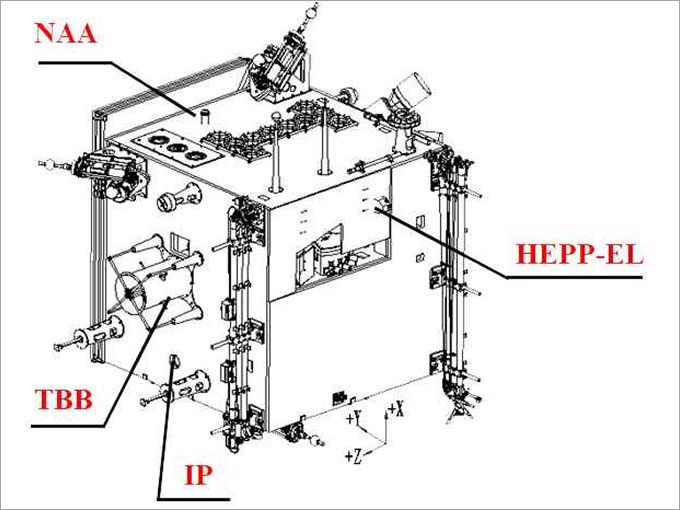
Diagram of CSES-01 and the onboard instruments.
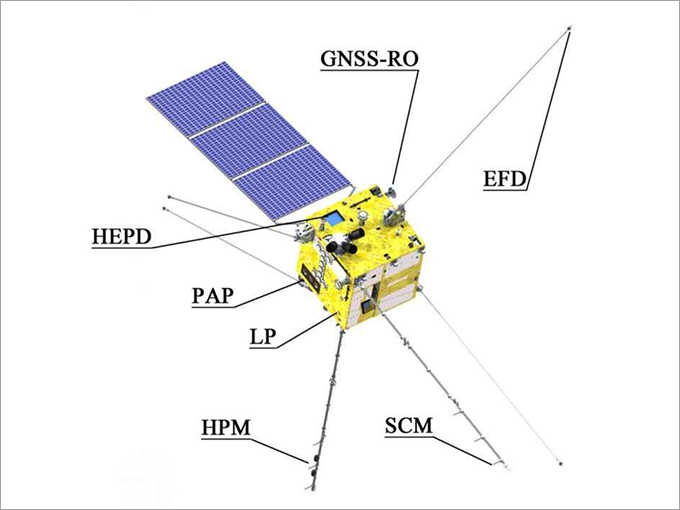
Diagram of CSES-01 and the onboard instruments.
The onboard payloads include:
Details about each payload and their observational targets are reported in the table below.
| Category | Payload Name | Observation Target |
|---|---|---|
| Energy Particle | High Energy Particle Detector (HEPD) | Proton: 30 Mev ~ 200 Mev Electron: 3 ~ 100 Mev |
| High Energy Particle Detector (HEPD) | Electron: 25 KeV ~ 3.2 MeV | |
| Electro-Magnetic Field | Electric Field Detectors (EFD) | Electric Field DC ~ 3.5 MHz |
| High Precision Magnetometer (HPM) • Vector Magnetic Field: FGM1, FMG2. • Scalar Magnetic Field: CDSM, CPT. |
Magnetic Field: 10 Hz ~ 20 kHz | |
| Search Coil Magnetometer (SCM) | Magnetic Field: 10 Hz ~ 20 kHz | |
| In Situ Plasma | Plasma Analyzer Package (PAP) |
Composition: H+, He+, O+ Ni: 5×10² ~ 1×10⁷ cm⁻³ Ti: 500K ~ 10000 cm⁻³ |
| Langmuir Probe (LP) |
Ni: 5×10² ~ 1×10⁷ cm⁻³ Ti: 500K ~ 10000 cm⁻³ |
|
| Plasma Profile Construction | GNSS Occultation Receiver | TEC by transmit VH/U/L Signal |
| Tri-Band Beacon | TEC by transmit VH/U/L Signal | |
| Ionospheric | O₂ 135.6 nm and N₂ LBH airglow |
Both HEPD-02 and EFD-02 incorporate several technological improvements over their counterparts flown on CSES-01.
CSES-02 is built on the same CAST2000 satellite platform as CSES-01, developed by DFH Satellite Co., Ltd., with several enhancements.
Key specifications include:
CSES-02 will operate in a Sun-synchronous polar orbit, identical to that of CSES-01:
CSES-02 relies on an Earth oriented 3-axis stabilization system with an Attitude Pointing Accuracy ≤0.1°(3σ).
It will be injected into the same orbital plane with a 180° phase shift, enabling a complementary ground track. This configuration effectively reduces the revisit time from 5 days to 2.5 days, significantly improving temporal resolution and correlation capabilities, and establishing a new dual-satellite system for ionospheric monitoring.
Unlike CSES-01, whose payload operations were initially limited to latitudes between ±65° (later expanded to ±70°), CSES-02 will enable full-orbit payload operation, greatly enhancing coverage and broadening the range of scientific investigations.
in depth
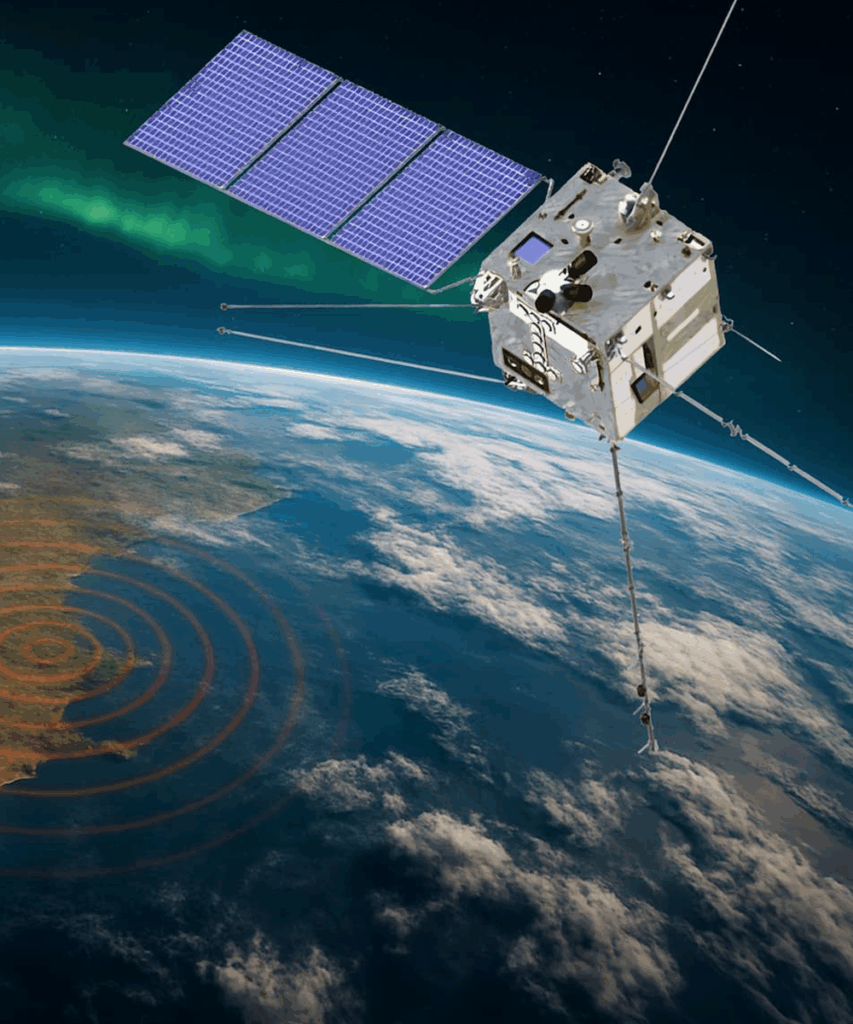
CSES-02 satellite is based on the Chinese CAST2000 platform. It has a mass of 900 kg...
Read more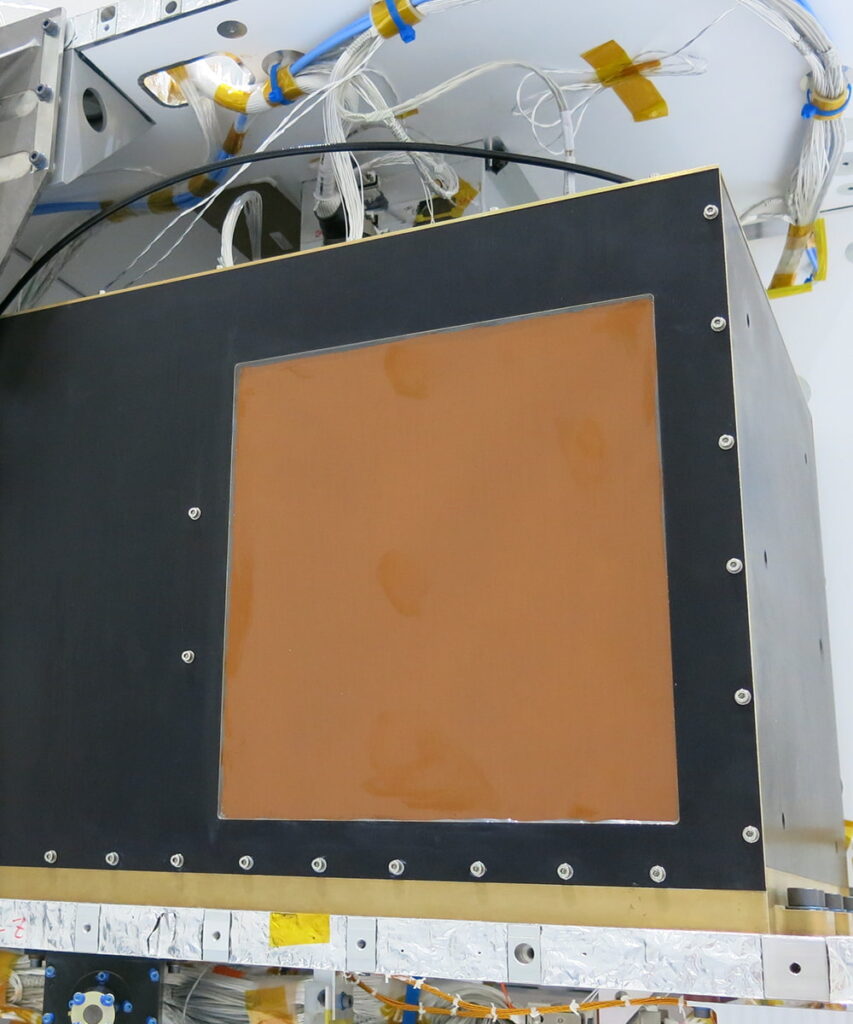
HEPD-02 has been designed to meet the demanding tasks of an excellent particle detector in...
Read more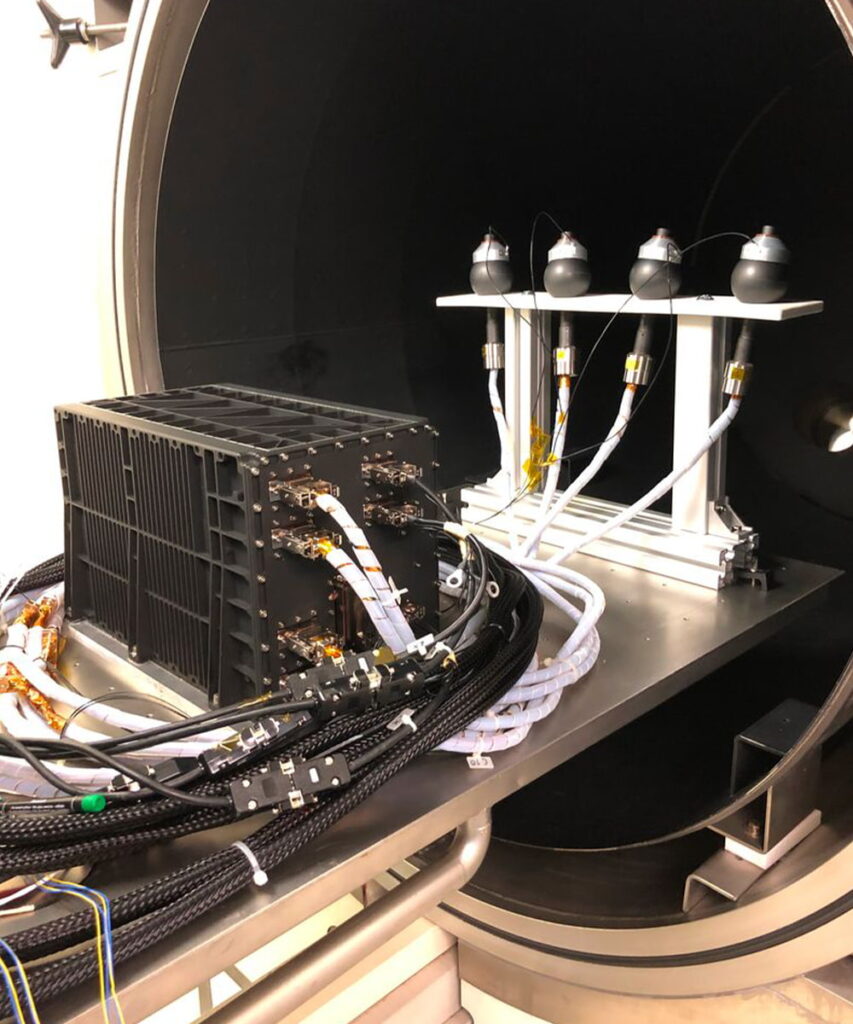
The EFD-02 (Electric Field Detector) allows us to measure the electric field components in a...
Read more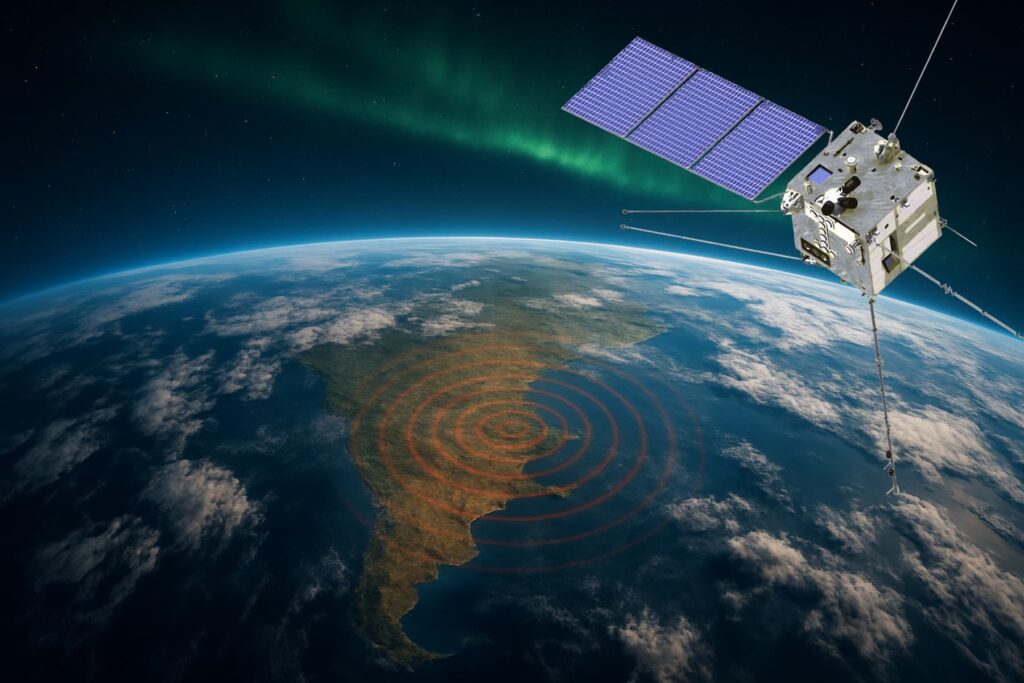
Read more